
SCR vs SSR for Electric Heaters:Differences and Selection
Choose an SSR with a suitable PID temperature controller when time-proportioned switching meets the heater's response requirements. Choose an SCR power controller when the application needs finer control within each AC cycle, managed starting current, or electrical feedback. The useful comparison is between complete control arrangements, including the heater, sensor and controller.
Both approaches can regulate industrial heating accurately. A switching device's name alone does not establish the temperature stability you will achieve.
What SCR and SSR Mean in a Heating System
An SCR is a silicon-controlled rectifier, a type of thyristor. An SSR is a solid-state relay: a device that switches a load electronically. These terms overlap because an AC SSR can use thyristors internally.
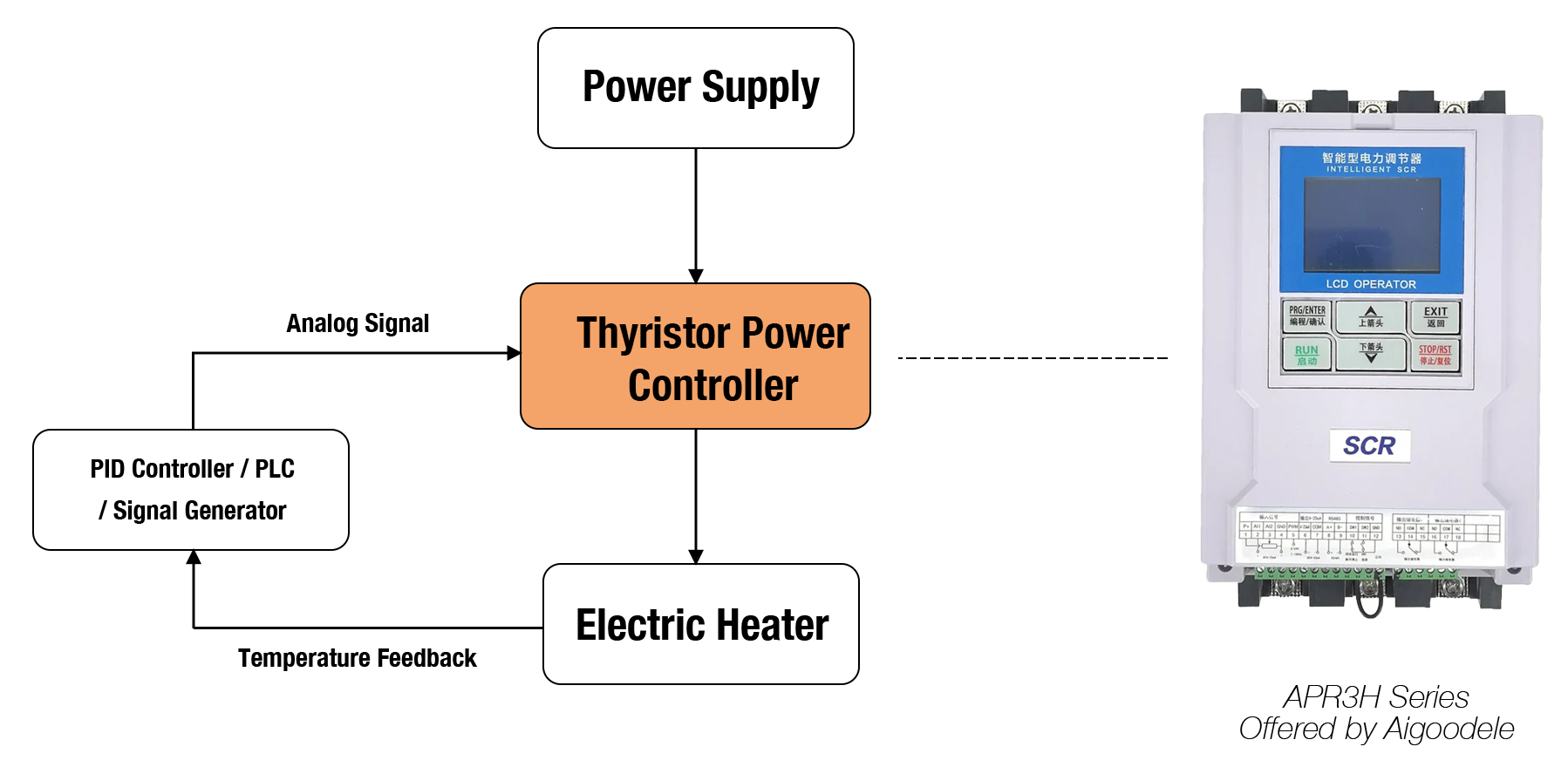
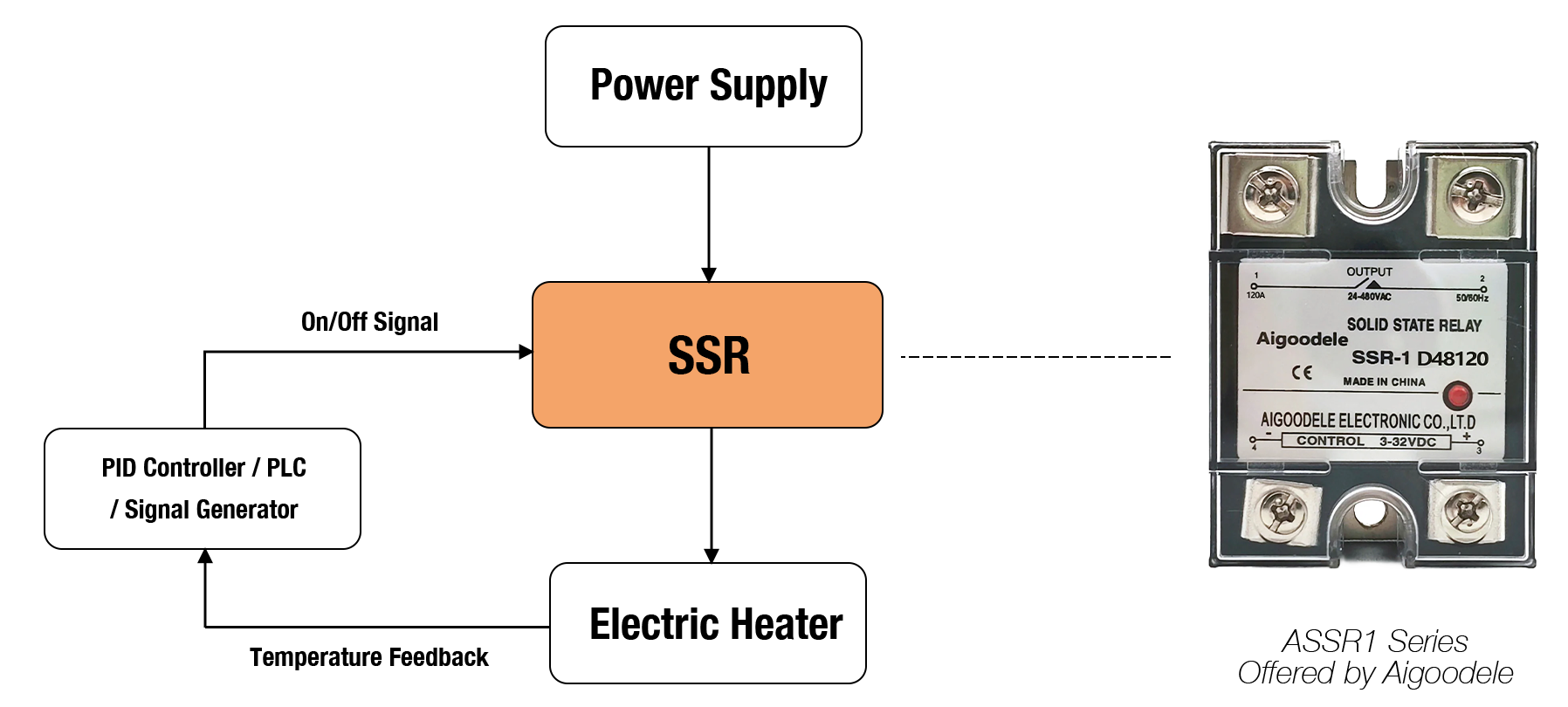
For this comparison, SSR means a conventional AC switching relay driven by a temperature controller's pulse output. SCR power controller means a dedicated heater power-control unit with a firing circuit and, depending on the model, configurable control modes, feedback and diagnostics. Specialized proportional SSRs and integrated controllers can cross these categories, so check the actual functions.
A proportional-integral-derivative (PID) temperature controller uses the difference between measured and target temperature to calculate a heating demand. The power device then applies that demand to the heater. Unless the power controller includes a temperature-control loop and suitable sensor input, it still needs an external temperature controller or PLC to regulate temperature.
SCR power controller with analog demand
SSR with a time-proportioned pulse demand
How Their Control Methods Differ
A conventional SSR is either conducting or off, but the temperature controller can vary its on-time. In a hypothetical two-second control period, one second on and one second off delivers approximately 50% of full-on average power to a fixed-resistance heater at constant supply voltage. This is time-proportioning control. The two-second period is an illustration, not a setting for every heater.
SCR controllers may use phase-angle firing, which varies the conducting portion of each AC half-cycle, or zero-cross burst firing, which passes selected cycles and skips others. A zero-cross controller can provide fine average-power adjustment without cutting each half-cycle. Compare the selected firing mode as well as the product category.
The illustration below shows how each example delivers the same average power in a different pattern. Time proportioning and burst firing both vary on-time; burst firing applies that principle to complete AC cycles. Their switching periods can overlap, and the firing method depends on the controller and its settings.

A heater with substantial thermal inertia can smooth these power pulses. A faster heater may respond to individual pulses, making the timing more important. Sensor response, placement and PID tuning also affect the result. It is therefore misleading to describe all SSR temperature control as low precision.
The table below compares common arrangements; optional functions must be verified for the specific model.
| Selection point | Conventional SSR + PID | Dedicated SCR power controller |
|---|---|---|
| Power adjustment | PID varies the proportion of time the relay conducts. | Phase-angle or burst firing, depending on model and settings. |
| Load suitability | Often suitable for stable-resistance heaters that tolerate the selected pulse period. | Evaluate for fast loads or changing resistance; verify the required firing and starting functions. |
| Temperature accuracy | Depends on the complete loop, including pulse period and thermal response. | Finer electrical control can help, but does not establish a temperature tolerance by itself. |
| Feedback and current limiting | A basic relay does not regulate measured power or limit current. Extra equipment may be needed. | May provide power/current feedback, soft start and limiting. These are model-specific features. |
| Electrical interference | Zero-cross switching generally reduces switching noise compared with phase-angle firing. | Phase-angle firing needs attention to electrical noise. Burst firing has different supply-loading effects. |
| Cost comparison | Compare relay, PID controller, cooling and required monitoring together. | Compare the complete unit and installation against the functions it replaces or adds. |
Use the table to compare the complete control arrangement. A controller with phase-angle firing is not automatically the best choice for a slowly responding heater, and a zero-cross device is not automatically a basic thermostat.
Choose for the Heater and the Process
The following are illustrative selection scenarios, not customer test results.
A slowly responding heated tank. With suitable resistive elements and substantial thermal mass, an SSR driven by PID may meet the required temperature stability. Check the acceptable temperature band and switching period before paying for functions the process does not need.
A fast infrared heating process. If the emitter reacts quickly to individual power pulses, evaluate phase-angle control. For emitters with high cold-start current, verify soft start and active current limiting against the heater manufacturer's requirements. An SCR label alone does not guarantee either function.
A heater whose resistance changes during operation. Decide whether the process needs controlled voltage, current or measured power. A power controller with the appropriate feedback can address an electrical requirement that a basic switching relay does not measure. Confirm what is sensed, how it is regulated and which limits remain active.
What to Confirm Before Ordering
Write the requirement in terms of the load and control loop. Include the supply voltage and phase configuration, heater material, full-load current, cold-start behavior, required temperature tolerance, and available control signal. Then identify the functions that are actually needed: basic time-proportioned switching, phase-angle firing, electrical feedback, current limiting or fault monitoring.
Check the cooling and protection requirements in the selected model's documentation. Panel temperature, heat-sink installation and protective devices belong in the selection, not just the relay or controller's headline rating. Both choices use power semiconductors that must operate within their specified limits.
Select the simplest arrangement that meets the measured process requirement, and specify each additional control function explicitly.
Browse industrial solid-state relays for SSR-based systems, or compare SCR power controllers for electric heaters when the application needs a dedicated power-control unit. For a three-phase installation, use the three-phase thyristor controller range and check the individual model documentation.